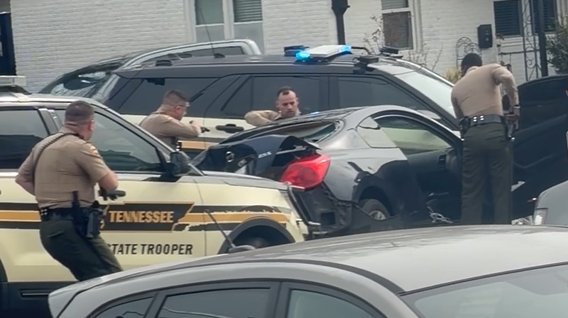


The head of the Tennessee Highway Patrol told legislators Thursday he would look into accounts of troopers conducting high-speed chases in Memphis that started following minor infractions such as failing to dim bright lights.
“I’m going to look at it,’’ Col. Matt Perry said during a budget hearing of the House Finance, Ways & Means Committee. Perry’s pledge came as legislators discussed an article by the Institute for Public Service Reporting that identified a number of volatile vehicle pursuits by state troopers.
A special report last month by The Institute in collaboration with Lighthouse Reports identified 75 vehicle pursuits during the Memphis Safe Task Force’s first five weeks of operation, from Sept. 29 to Nov. 3.
At that rate, an average of more than two per day, the task force would tally 780 vehicle pursuits in a year — a remarkable number considering the Memphis Police Department has averaged 144 pursuits annually in recent years, an average of 2-3 per week.
Sixty-six of those pursuits (88 percent) were conducted by the Tennessee Highway Patrol (THP), a task force member.
In all, 32 of the 75 chases (43 percent) resulted in accidents. Twenty-nine of those accidents (91 percent) involved chases by THP, The Institute’s analysis of arrest affidavits found.
The pursuits often were initiated following infractions as minor as a missing headlight or a broken taillight or driving without a seatbelt.

Under questioning by Democratic committee members Bob Freeman of Nashville and Antonio Parkinson of Memphis, Col. Perry identified a few reasons for the large number of vehicle pursuits:
- There are a lot more troopers working in Memphis and Shelby County now. “We had eight troopers working in Shelby County in 2019,’’ Perry said. But a buildup by Gov. Bill Lee before and after President Trump launched the Memphis Safe Task Force in late September has reversed those low numbers. “Now we’ve got roughly 100 (troopers) every minute of every day working,’’ Perry said.
- Motorists flee from law enforcement more often in Memphis than in other parts of the state. “Historically, people have run or fled police in Shelby County at high numbers,’’ Perry said.
- THP’s vehicle pursuit policy is less restrictive than the policies of some law enforcement agencies. “We have a good, robust policy,’’ Perry said. Pursuits are monitored by supervisors, and troopers must consider a variety of factors including traffic and weather conditions, Perry said. “We terminate probably more than we actually see to the end,’’ he said.
Given that, the number of pursuits during the Memphis Safe Task Force’s first five weeks could be much higher than the 75 identified by The Institute as reporters only reviewed pursuits that ended in an arrest. The Institute did not have access to records involving pursuits in which the suspect got away.
“There was a time when our policy probably gave troopers a little more flexibility,’’ Perry said. “… You can’t have tunnel vision. You have to end the pursuit when you know it’s going (into) unsafe areas, you know, areas where the public frequents, certainly pedestrian traffic. So, troopers have to end pursuits themselves. And when they don’t and when they do things that put themselves in danger or the public, then we discipline them.”
State declines to release the Tennessee Highway Patrol’s vehicle pursuit policy. Read the story.
Perry’s public comments follow state officials’ refusal last month to allow a reporter to interview a THP representative to discuss vehicle pursuit practices. Then on Friday, the day after the legislative hearing, attorneys for the Tennessee Department of Safety & Homeland Security, which oversees THP, declined a request by The Institute to obtain a copy of THP’s vehicle pursuit policy. In a written response to The Institute’s Feb. 4 request for a copy of the policy, attorneys Casey Goggin and Mary Peterson said the request “must be denied because the requested document is confidential’’ under state law.
Many law enforcement agencies would not allow the type of pursuits that THP conducts, said Dennis Kenney, a professor at the John Jay College of Criminal Justice at the City University of New York, who reviewed a smattering of arrest affidavits at The Institute’s request.
“So, pursuits are something that most police departments for the last 20 years or so have tried to restrain to the extent possible,’’ Kenney said.
The Memphis Police Department authorizes vehicle pursuits “only when an officer has probable cause to believe that one or more occupants of a fleeing vehicle have committed a violent felony.’’

As many as opens in a new window30-45 percent of police vehicle pursuits result in an accident, studies show. And more than one person is opens in a new windowkilled every day on average in the U.S. as a result of police vehicle pursuits. Two fleeing drivers have died in crashes during vehicle pursuits since the Memphis Safe Task Force began operations last fall.
A opens in a new windowpolicy paper sponsored by the U.S. Department of Justice’s Office of Community Oriented Policing Services in 2023 recommends that pursuits take place only when a violent crime has been committed and the suspect “poses an imminent threat to commit another violent crime.’’
“If those two conditions are not met, agencies need to look for alternatives to accomplish the same objective,’’ wrote Chuck Wexler, executive director of the Police Executive Research Forum, a think tank that advises police agencies across the country.
“You can get a suspect another day, but you can’t get a life back,’’ Wexler wrote.
But in last week’s legislative hearing, THP’s Col. Perry said troopers must weigh the risk of a pursuit against the prospect of letting dangerous criminals go free.
“It is a dangerous thing. But somebody has to catch really bad people doing really bad things,’’ he said.
Both Democrats and Republicans on the committee acknowledged that THP’s beefed-up presence in Memphis has helped reduce the city’s notoriously high violent crime rate.

“We’re done living in fear,’’ Rep. John Gillespie, R-Memphis, told Col. Perry. “We are no longer going to live in fear in Memphis. Because of your work we are not living in fear now.’’
THP began ramping up its presence in Memphis several years ago, in part because of requests from the city administration for help in reducing an outbreak of shootings on the interstate system.
“The shootings on the interstate system of Memphis since the troopers have been there are close to zero,’’ Department of Safety & Homeland Security Commissioner Jeff Long told legislators.
The Institute’s review of arrest affidavits shows THP is taking bad actors off the road. Arrests connected to the 66 THP vehicle pursuits include at least 10 people charged with drunken driving. Eleven were charged with motor vehicle theft.
At the same time, many pursuits were initiated following attempts to stop motorists for relatively minor infractions, The Institute’s analysis found. Among THP’s 66 vehicle pursuits, as many as 32 (48 percent) were initiated after troopers attempted to pull over motorists for vehicle equipment violations such as a missing headlight or broken taillight, or other minor infractions like excessively tinted windows and expired temporary tags.
One incident in October involved a 17-minute chase through Whitehaven initiated after a motorist failed to dim his bright lights. According to an affidavit, passengers in the fleeing car included a mother and her infant child. The motorist struck a patrol car as a trooper attempted to box in the fleeing vehicle, causing the patrol car to strike a utility pole. The chase ended when a second trooper “demonstrated a tactical vehicle intervention,” striking the fleeing vehicle and “causing (it) to come to (a) final rest after striking a tree,” the affidavit said.
Rep. Parkinson cited the incident in asking Col. Perry to review THP’s pursuit policy.
“It’s not a felony pursuit, obviously, right?’’ Parkinson said. “And so, I’m asking you to take a look at that if you will.’’