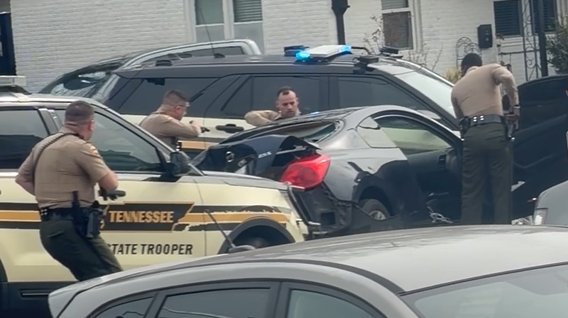




When Tennessee Gov. Bill Lee signed legislation last year that dismantled a local Memphis ordinance aimed at limiting pretextual stops, he described these types of traffic stops as “tools” available to law enforcement.
Yes, oversight is needed to ensure police act within lawful parameters, Lee said. But police shouldn’t lose tools available to them at the cost of public safety, he said.
The overturned ordinance, the Driving Equality Act in Honor of Tyre Nichols, had been passed by the Memphis City Council months after the namesake of the ordinance, Nichols, was killed by Memphis police following a traffic stop.
Lee’s line of reasoning is a familiar one. Proponents of pretextual policing, or the strategy of using minor infractions to stop motorists and then search for other crimes, will point to major nabs over history: Timothy McVeigh, the domestic terrorist responsible for the Oklahoma City bombing, was arrested after being pulled over for driving without a license plate as was serial killer Joel Rifkin.
Tennessee state Sen. Brent Taylor, who introduced the bill that overturned the Memphis ordinance banning a variety of stops for minor infractions, said in a statement at the time that pretextual stops are essential in the ongoing pursuit of a lower violent crime rate in Memphis.
“Violent crime has reached a crisis level in Memphis. Police officers and deputy sheriff’s (sic) need to have more tools available to combat rising crime, not fewer,’’ said Taylor, who represents East Memphis and parts of eastern Shelby County. “Routine traffic stops have resulted in major arrests and the apprehension of violent criminals for years.”
Taylor’s successful legislation, he said, “will make our communities safer and ensure law enforcement officers can do their jobs.”
An eight-month review of marijuana-related arrests by the Institute of Public Service Reporting found multiple instances where traffic stops for minor infractions led to the recovery of stolen vehicles and firearms, as well as stashes of illicit drugs like fentanyl or cocaine.

One such case involved convicted carjacker Daylon Onry, who was pulled over last June for driving with expired tags. According to an arrest affidavit, Onry then sped away and led police on a chase that ended after he crashed into a utility pole. The car he was driving was stolen. Inside, police found a black Glock handgun with a switch that converted it to a fully automatic “machine gun,’’ the report said.
Onry, 21, pleaded guilty in February to auto theft and to a previous carjacking from 2023. He was sentenced to 10 years in prison.
Traffic stops can also help secure search warrants. In one instance reviewed by The Institute, detectives surveilled a potential target for a narcotics investigation and executed a search warrant after observing him driving without a seatbelt. The suspect also was charged with driving without insurance, a fact police knew beforehand.
The subsequent search of the suspect’s Orange Mound home yielded roughly 11 pounds of marijuana, more than enough for a felony conviction in even the most marijuana-friendly states. Officers also recovered cocaine, a shotgun and a stolen semi-automatic handgun.
The net of pretextual stops has also ensnared drivers with warrants in other states, with the same data set showing a handful of arrests of drivers who skipped out on court.
When considering the full picture of crime in Memphis, Mike Williams, former president of the Memphis Police Association, has seen the value of pretextual stops over the course of his career.
“I do think they’re needed,” Williams said in an interview with The Institute. “I do think they allow at the ability to get at bigger things.”
The law is the law, Williams said. Registration needs to be renewed. Headlights need to be functioning. A driver must have insurance.
And, in Williams’ view, many in Memphis routinely operate vehicles without regard to these requirements.
“We have so many people operating outside the constraints of the law — they don’t have insurance, for example — and we don’t know that until we pull them over,” Williams said. Non-moving offenses like driving without insurance often impact others who “are operating within the contraints of the law,” he said:
“You have someone who is working hard to pay their car insurance, pay their car note…and then here comes someone operating outside of the law that can rock their world.”
In conjunction with pretextual stops, Memphis police also have a valuable tool in the use of marijuana odor — distinct and unmistakable — as a means to trigger searches of drivers and vehicles.
While both moving offenses like speeding or running a stop sign and non-moving offenses like driving with expired tags or a broken taillight serve as a basis for many traffic stops, the smell of burnt and unburnt marijuana odor emanating from a vehicle is often used as probable cause for warrantless vehicle searches in Tennessee.
Searches based on this secondary factor routinely produce results. Across a six-month stretch from last April to September, The Institute identified 93 arrests during traffic stops after an officer smelled marijuana.
These searches collectively resulted in officers seizing nearly 10 pounds of marijuana. In several instances, the driver had a prior felony and was illegally carrying a firearm. A handful of other instances produced a driver with active warrants in other states.
Williams believes marijuana is close to being legalized at the federal level. Until then, he said, officers are obligated to follow state laws and investigate the distinct smell of marijuana.
“Whatever the legislators in that particular area, whatever they legislate, it’s incumbent on the officers to enforce. That’s what police have to go by, period,” Williams said.