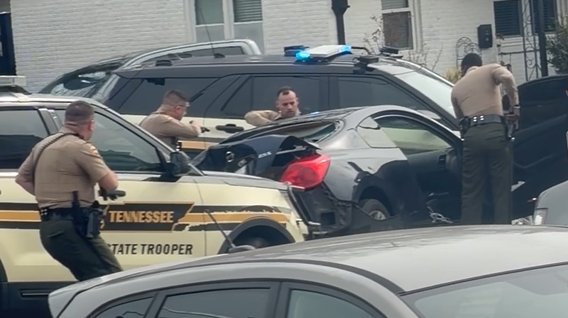


State officials have declined to release the Tennessee Highway Patrol’s vehicle pursuit policy, maintaining it is not subject to the Tennessee Public Records Act.
In a letter sent late Friday, attorneys for the Tennessee Department of Safey & Homeland Security, which oversees THP, told the Institute for Public Service Reporting it would not release the policy.
“Your request for the Tennessee Highway Patrol’s policy regarding pursuits must be denied because the requested document is confidential,’’ Senior Associate Counsel Casey Goggin and Associate Counsel Mary Peterson said in the Feb. 27 letter.
But an open records advocate on Sunday questioned the accuracy of the attorneys’ contention that the policy is confidential under state law.

Deborah Fisher, executive director of the Tennessee Coalition for Open Government, also said releasing such documents can enhance confidence in law enforcement.
“First, law enforcement pursuit policies are historically public information — as they should be because they outline the policy of our police departments that govern an activity that can be dangerous to bystanders and innocent drivers on the road,’’ Fisher said in an emailed statement.
An investigation last month by The Institute identified 75 vehicle pursuits over the Memphis Safe Task Force’s first five weeks of operation, from Sept. 29 to Nov. 3.
At that rate, an average of more than two per day, the task force would tally 780 vehicle pursuits in a year — a remarkable number considering the Memphis Police Department has averaged 144 pursuits annually in recent years, an average of 2-3 per week.
The Institute’s analysis found that the overwhelming majority of the task force’s vehicle pursuits — 66 (88 percent) — were conducted by the Tennessee Highway Patrol (THP), which has mushroomed in size here since September when Gov. Bill Lee began sending scores of troopers to Memphis to aid the surge.
In all, 32 of the 75 chases (43 percent) resulted in accidents. Twenty-nine of those accidents (91 percent) involved chases by THP. Overall, two fleeing drivers have died in crashes since the Memphis Safe Task Force began operations in late September.
Tennessee Highway Patrol chief says he’ll review vehicle pursuit practices. Read the story.
Many policies governing vehicle pursuits by law enforcement agencies in Tennessee can be found “with a quick search on the web,’’ Fisher said. As an example, she pointed to the Knoxville Police Department, which allows pursuits when an individual is suspected of committing a felony or a serious misdemeanor. The Memphis Police Department authorizes vehicle pursuits “only when an officer has probable cause to believe that one or more occupants of a fleeing vehicle have committed a violent felony.’’
“That in and of itself indicates that no one thinks there is anything dangerous about releasing such policies,’’ Fisher said. “In fact, it supports confidence in our law enforcement because we know they have guardrails in place and aren’t simply free to put citizens in danger with reckless driving and behavior.”
In denying The Institute’s request for THP’s policy, the state’s attorneys cited an exemption to the Tennessee Public Records Act that appears to protect government “electronic information processing systems, telecommunication systems, or other communications systems” from unauthorized access.
State Rep. Antonio Parkinson, D-Memphis, who has asked THP to review its vehicle pursuit practices, said Sunday it sounds like the exemption the attorneys are citing amounts to “an attempt at a catchall.’’ However, he said he needs more information before concluding whether the state should be required to release the pursuit policy.
TCOG’s Fisher said, “The exemption that the Tennessee Highway Patrol is relying upon has nothing to do with police policies. It does not mention law enforcement at all.”
If a portion of THP’s policy contains information that would allow someone unauthorized access its communications system, that information could be redacted, Fisher said.
“Unfortunately, THP does not even explain what part of this exemption could apply and why, which is also excessive secretiveness,’’ she said. “Tennesseans deserve better. THP should not be allowed to operate without any accountability to the public.”