




Last week, as President Donald Trump addressed hundreds of National Guard personnel and federal agents inside a hangar at the Memphis Air National Guard Base, he railed repeatedly against Democrats, as he often does. Yet, even then, there was one Democrat whom Trump showered with praise.
“Your mayor has been terrific,” Trump said, thanking Memphis Mayor Paul Young while boasting about the achievements of the Memphis Safe Task Force and declaring that the city’s long-running crime problem had been ‘fixed’.
The praise comes as Young continues to publicly embrace Trump’s task force and avoids criticism, even when directly questioned about reported abuses and excesses.
For instance, Young stayed silent about privacy concerns surrounding armed task force teams entering hotels and motels in the city and, without warrants, asking for copies of entire guest registries. He has not commented on the threefold surge in immigrant street arrests by U.S. Immigration and Customs Enforcement in Shelby County after the arrival of the task force, with more than 90 percent of them involving individuals without any criminal convictions. The Institute for Public Service Reporting has reported on and repeatedly sought Young’s comments on each of these concerns, but the mayor has refused to respond to them.

Young told reporters that he had been invited to sit in the audience at Trump’s event, but didn’t attend because he “had a conflict”. Hours after the event, when The Institute asked Young about his reaction to Trump’s praise, he said, “As Mayor, I’ve learned not to get too high off praise or too low off criticism. I stay focused on the residents of our community. If their lives are better, I consider that a win.” He added, “We have been intentional about this work from day one, with a community-focused strategy to reduce violent crime. We are seeing real progress … We have to sustain the gains on safety while expanding opportunity.”
On one hand, Young generally points out there was a downward trend in crime even before the task force began operations in September. On the other, he has largely been appreciative of the task force’s presence in the city. This allows Young to partake in the credit for any success the task force claims in reducing crime in Memphis. It also effectively makes it more difficult for him to criticize the task force over its faults, shortcomings or excesses.
At times, Young has skirted around discussing the task force entirely. In his State of the City address in February, for example, Young avoided speaking about the task force at all, even as protesters heckled him about it.
What makes the mayor’s silence especially noteworthy is that he is, in many ways, best positioned to offer the most insightful critique of the task force and its shortcomings. As his police department coordinates with federal agents, it offers him a ringside view of the task force’s excesses.
For instance, in November, when The Institute was the first to report that task force teams were entering city hotels and motels and asking for guest registries, the report noted the direct involvement of the Memphis Police Department in one such operation. Yet the mayor provided no response or clarity as to why the city police were engaging in such actions.
The mayor’s choice to not criticize the task force has resulted in receiving praise from the president, and before that from then-secretary of the Department of Homeland Security Kristi Noem. But it does nothing to address the task force’s actual problems.
Community Concerns Persist
Hours after Trump’s event, Young said at a press conference, “There’s been a lot of conversations over the past six months around how the task force is going to show up in our community, and my goal is to make sure that as the mayor of Memphis that I’m at the table helping to drive how the federal agencies showed up in our community.”
One of the ways the task force has shown up in the community is through a surge of ICE street arrests. An analysis of federal immigration data by The Institute found that street arrests by ICE nearly tripled in Shelby County after the Memphis Safe Task Force began operations, and 91 percent of immigrants apprehended in those street arrests during the task force’s first 17 days had no criminal record.
The Institute has repeatedly sought Young’s responses to these findings but to no avail.

At the Trump event on Monday, ICE director Todd Lyons provided more data about immigration arrests in Memphis under the task force. Lyons said, “While this wasn’t an immigration-led operation, sir, we did have 619 illegal aliens arrested.” Previous reporting by the Institute has shown that nearly six of every ten ICE arrests in Tennessee since Trump took office involve individuals with no criminal convictions. Similar statistics of ICE arrests in Shelby County also contradict the Trump administration’s claims of their immigration enforcement operations targeting the “worst of the worst”. Yet again, Young has hardly criticized the ICE arrests made under the Task Force.
When questioned on the sidelines of his State of the City address about whether he should be more vocal in opposing ICE operations in the city, Young had reportedly said, “I’ve been very clear on my position with regards to ICE… They are a part of the federal task force. The federal task force was intended to focus on violent crime, so my goal has been to work with that task force on violent crime. We embed those agencies, not just Homeland Security and ICE, but FBI, DEA, ATF, U.S. Marshals. We embed them with our police officers, focus them on executing warrants, focus them on organized crime-pointed efforts, focus them on multi-agency gang efforts. That’s why you may see them (ICE agents) with them (Memphis police), but when they’re with our police officers, they’re not focused on immigration.”
Time and again, such responses have exemplified Young’s sidestepping of the issue and overall reluctance to criticize the actions of federal agents, even on matters such as ICE arresting large numbers of individuals with no criminal convictions.
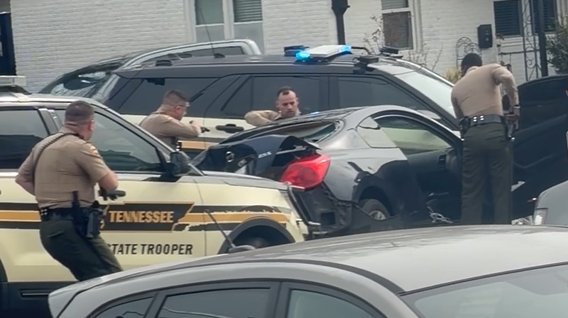
Another example of the task force’s actions in the community has been the dozens of risky, at times accident-triggering vehicle pursuits, often initiated following infractions as minor as a missing headlight, a broken taillight, or driving without a seatbelt. Analyzing arrest affidavits, The Institute identified 75 vehicle pursuits over the task force’s first five weeks of operation, from Sept. 29 to Nov. 3. In all, 32 of the 75 chases (43 percent) resulted in accidents. Yet again, the mayor hasn’t publicly commented on the concerns regarding these actions by the task force, and the public safety threats it caused.
Given this overall approach by Young to the task force and its impact on the city, it wasn’t altogether a surprise to hear Trump saying that the mayor has been ‘terrific’, or that he was the only Democrat to receive praise during the roundtable about successes of the Memphis Safe Task Force. Whether this approach will help Young politically remains to be seen — the next Memphis mayoral election is in October 2027. But what is clear, however, is that Young’s administration isn’t among those attempting to act as checks and balances to the activities and excesses of the Memphis Safe Task Force.


