


Water, water, everywhere underneath us, and not a drop to waste. Or contaminate. Or pave over. Or mismanage. Or take for granted.
That’s the fundamental message behind The Blue Print, a new proposal for a first-ever Groundwater Protection Plan for the Memphis Aquifer, the ancient, underground source of all drinking water in Memphis and Shelby County.
The Blue Print, developed after years of research by the nonprofit Protect Our Aquifer, will be presented Thursday to the Shelby County Ground Water Quality Control Board. Copies also will be given today to MLGW board members. The Institute for Public Service Reporting obtained an advance copy.
“As other regions grapple with severe droughts, people and industries will relocate to water-rich areas like ours increasing the pressure and strain on our shared aquifer resources,” says The Blue Print. “We stand at a critical moment, armed with more knowledge than ever, knowing that ‘business as usual’ simply will not do. We need action, we need change and we need to create that together.”
The Blue Print details various threats to the Memphis Aquifer, including current and potential contamination, known and suspected breaches in the aquifer’s protective layers, and overpumping and wasteful use of water.
The report says those and other “threats to water security” are exacerbated by limited and inconsistent water quality sampling, monitoring, and data management; regressive and inadequate water fees and rates; and poorly managed development, especially in the aquifer’s recharge zone.
“The reality is, our groundwater is unmanaged,” says The Blue Print. “New research continues to reveal more about our geology and threats of contamination. We must begin treating and managing the Memphis Sand Aquifer as the foundation of our livelihoods, because it truly is.”
Memphis is the largest city in America that obtains all its drinking water from groundwater rather than surface water. But hundreds of millions of gallons of pure aquifer water are also pumped every day for businesses and industries, farms and lawns, ponds and fountains, parks and golf courses.
The massive system of underground aquifers in the region is overseen by a patchwork of local, state, and federal codes, ordinances, laws, agencies, and utilities. That includes the Environmental Protection Agency, the Tennessee Department of Conservation, and MLGW.
That also includes the Groundwater Board, whose stated mission is to “secure, protect, and preserve the quality and quantity of groundwater.” But the board meets only four times a year, mostly to hear appeals for well permits. Its 11 volunteer members are appointed by city and county officials and local utilities.
The Groundwater Board was established in 1987, a few years after contamination was detected in municipal drinking water wells in South Memphis and Collierville. The board was charged with the creation of a “Groundwater Protection Plan” for Shelby County.
That plan still does not exist.
“Siloed operations with minimal community engagement has kept the creation of a comprehensive and actionable groundwater management plan out of reach,” The Blue Print says. Meanwhile, “new data and research indicate that our municipal wells are more vulnerable to contamination than we previously thought, threatening the public’s right to clean water.”
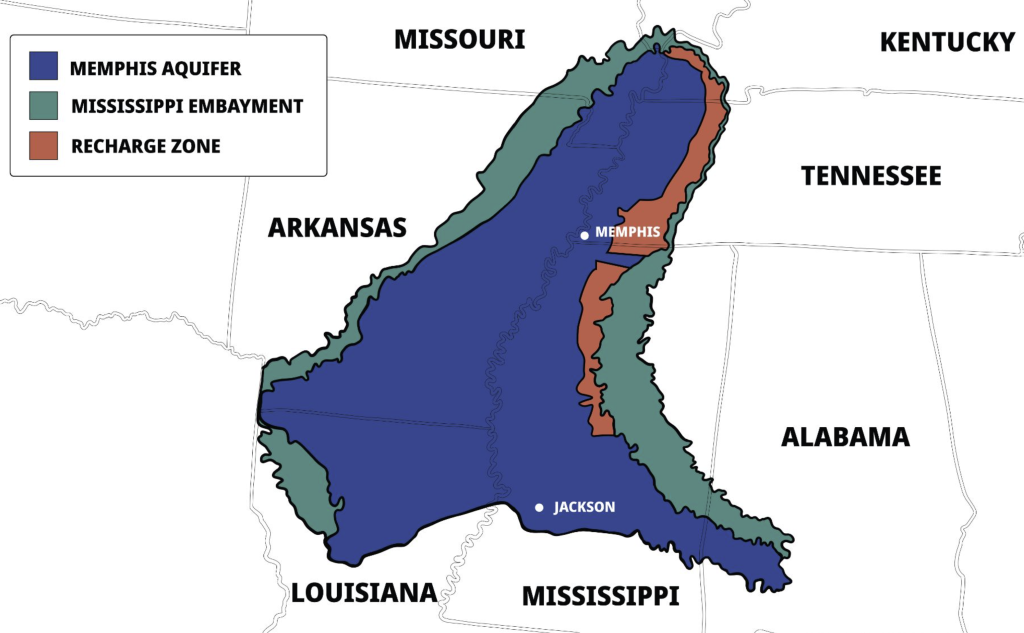
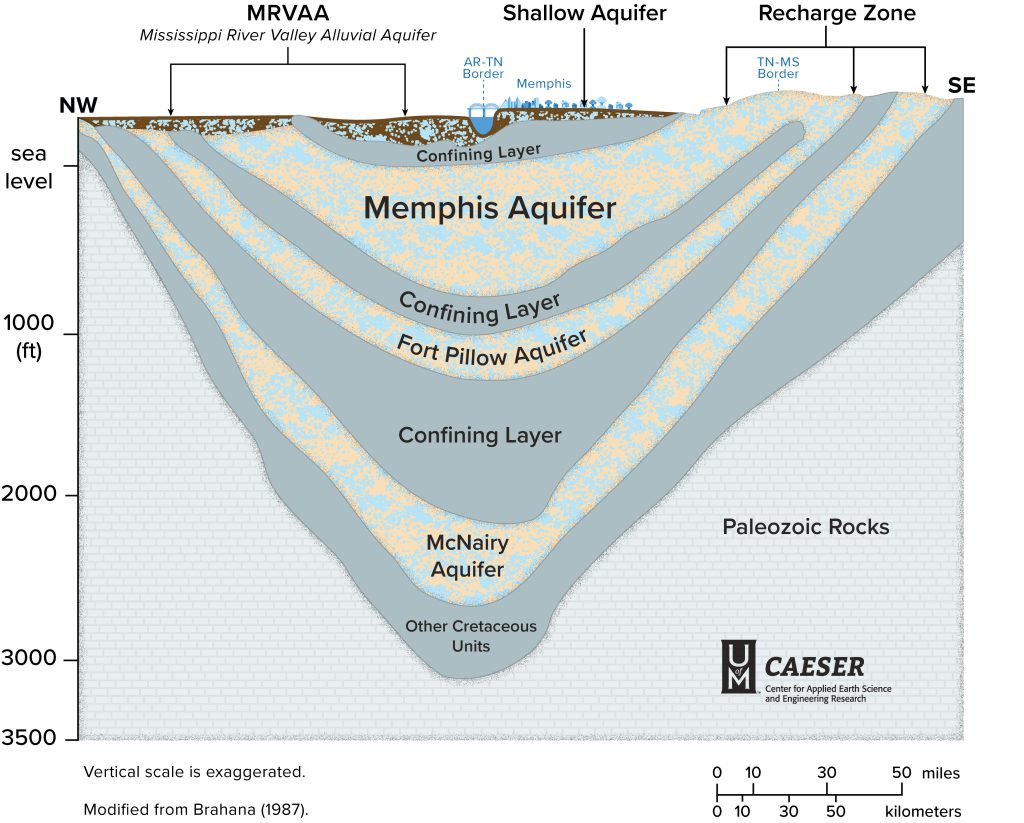
The Memphis Aquifer is an underground, water-saturated sand formation that spans West Tennessee, eastern Arkansas, northwest Mississippi, and parts of five other states.
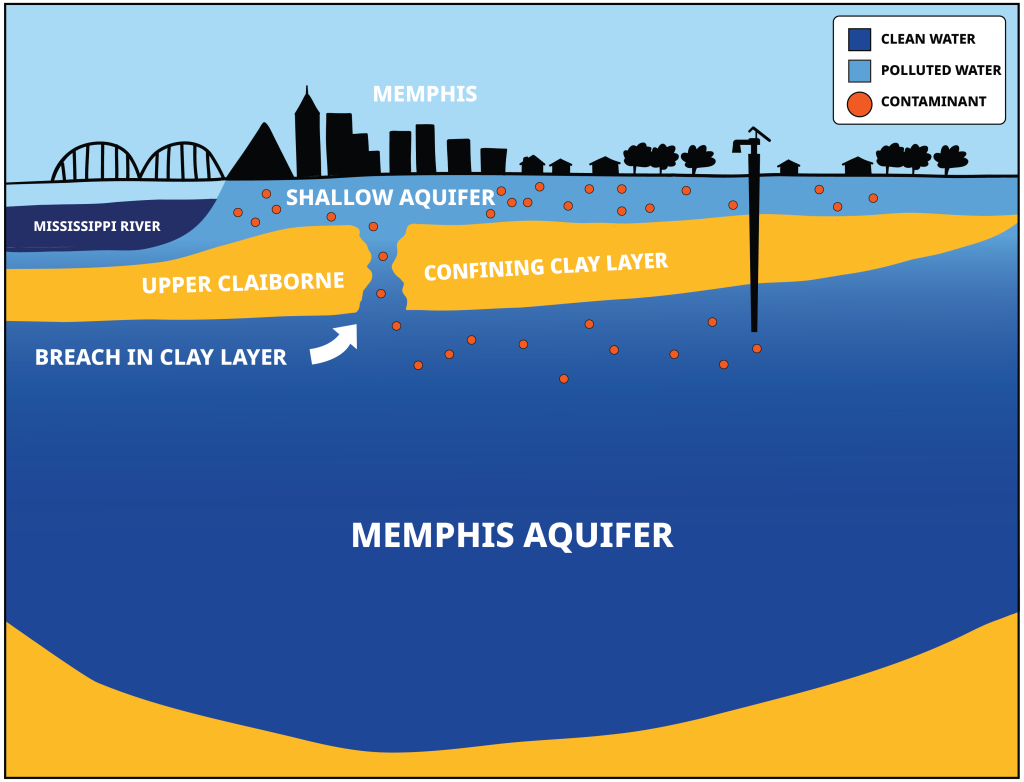
Aquifer water, estimated to be 2,000-3,000 years old, is stored between grains of sand. It is naturally filtered and protected by thick layers of sand, silt, gravel and clay. Those protective layers aren’t impenetrable.
In 2023, the Center for Applied Earth Science and Engineering Research (CAESER) at the University of Memphis and MLGW completed a 5-year, $5 million study of the Memphis Aquifer.
Prior to the study, there were six suspected natural “breaches” in the protective layer of clay over the aquifer. The study confirmed the six breaches and identified 36 other suspected breaches.
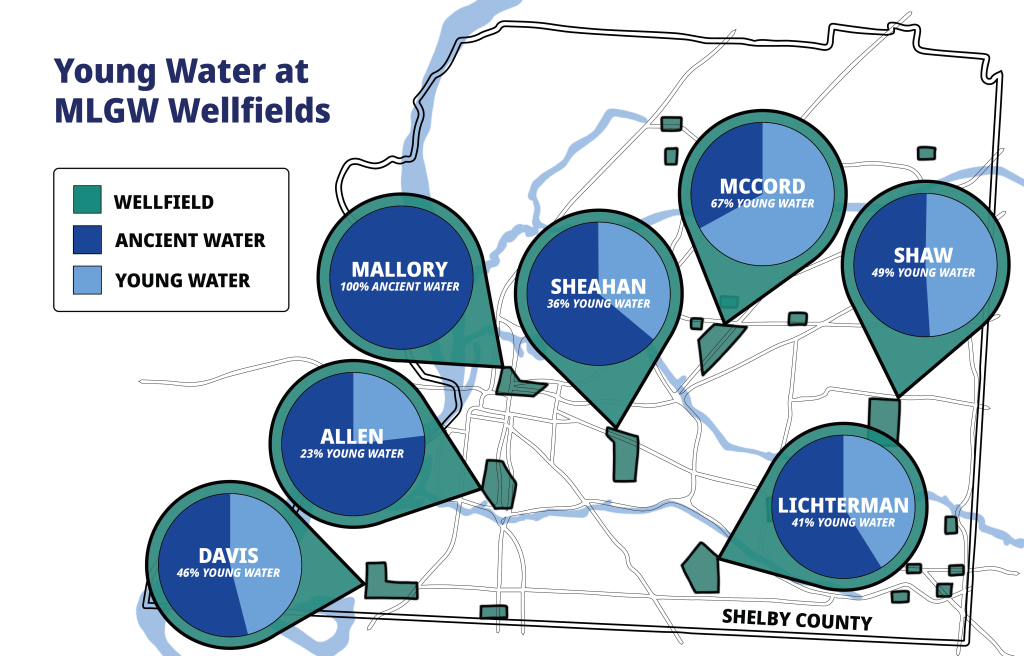
It also detected “modern water” (less than 60 years old) in six of MLGW’s 10 wellfields. Breaches allow younger water of poorer quality to seep into the aquifer.
In addition to the naturally occurring breaches, there are approximately 200 known chemical contamination sites across Shelby County – 10 of them federally-recognized Superfund Sites in active remediation.
“Breaches in the protective clay layer make our water vulnerable to contamination from ground surface including, industrial spills, leaking underground storage tanks (i.e., gas stations), dry cleaners, landfills, and other legacy pollution sites,” says The Blue Print.
“Over pumping of the aquifer has a drawdown effect, and we are pulling down groundwater levels around the well and sometimes the whole area, creating a ‘cone of depression.’ In parts where the protective clay layer is missing, this lowering of water levels can pull young water and contaminants down through these gaps in the clay layer into the underlying Memphis Aquifer.”
Breaches, contamination and over pumping/drawdown are some of the “threats to water security” detailed in The Blue Print. Others include limited and inconsistent water quality sampling, monitoring, and data management; wasteful use encouraged by regressive and inadequate fees; and poorly managed development, especially in the aquifer’s recharge zone.
The recharge zone is an area of eastern Shelby County and 11 rural West Tennessee counties where the aquifer’s protective layers thin out or disappear. It’s where “rainwater most directly replenishes” the aquifer “and groundwater is more vulnerable to contamination.”
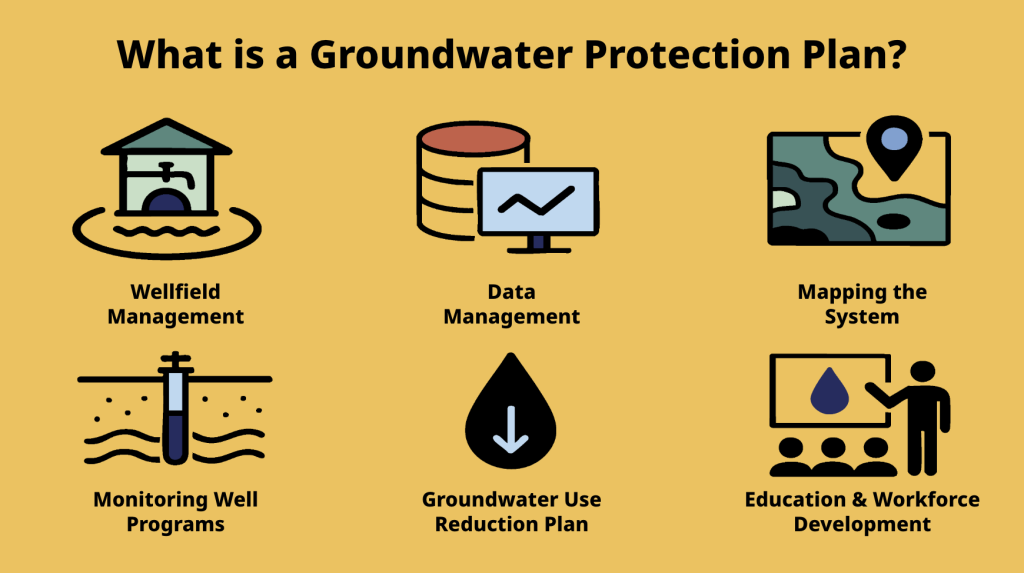
The Blue Print recommends several “best management practices” to protect the aquifer that should be included in a comprehensive Groundwater Protection Plan.
MAPPING
More extensive and precise geologic mapping of the Memphis Aquifer.
That includes mapping all existing areas of contamination, all confirmed and suspected natural “breaches” in the aquifer’s protective clay layer, and the entire 12-county recharge zone.
Middle and East Tennessee were mapped with TVA funding decades ago. Except for areas of eastern Shelby County, West Tennessee groundwater remains largely unmapped.
“Shelby County is plagued with legacy pollution where some sites have been well mapped and others are unknown threats to public health,” The Blue Print says. “Surficial geology helps us understand where the sands that feed the Memphis aquifer are exposed and most vulnerable… We need to establish a network of wells to detect and track toxic plumes deep underground before they reach drinking water wells.”
WATER SAMPLING
Regular, consistent, and widespread sampling of water quality of all wells.
Shelby County is punctured by hundreds of private residential, commercial and industrial wells that draw millions of gallons of water from the aquifer every day.
Private well owners pay an annual fee for the privilege. The county health department offers annual water sampling but only has the resources and expertise to test a relative handful every year.
In 2018, the county health department’s water quality branch used its own lab to test 437 of those wells. In 2019, the branch tested 403.
In 2020, the health department closed its in-house lab for lack of funding and began using a private lab that charges $495 per sample. Over the past six years, the water branch has tested 124 wells. That includes 37 samples in 2025.
“Homeowners who rely on private wells or septic systems often have little training in proper maintenance, leading to risks for both public health and water quality,” says The Blue Print. “These samples could provide valuable data for a wide range of stakeholders and purposes … (But) the (health department’s) sampling approach is inconsistent and lacks transparency.”
DATA MANAGEMENT
Improved and coordinated management and sharing of all data.
That includes digitizing the locations, status, and water quality of each of the hundreds of public and private wells in Shelby County.
“A strong groundwater protection program depends on accurate, accessible data,” says The Blue Print. “In Shelby County, however, one of the most significant threats to effective aquifer management is the lack of a unified, reliable system for well and septic records.”
MLGW and the county’s four other municipal utility companies are required by law to regularly monitor and test their own wells.
The health department’s three-person water quality branch is responsible for maintaining information on all private commercial, residential, and industrial wells, monitoring wells, and abandoned wells, as well as septic systems.
“Yet decades of poor record keeping, and lack of appropriate funding have left the county without a clear picture of where wells exist, at what depth, how much water they use, or if they are closed,” says The Blue Print.
“Without complete and organized data, (the health department) cannot accurately monitor water quality, enforce regulations, or collect the fees that fund its groundwater programs. The lack of a centralized database also prevents collaboration with utilities, planners, and researchers, leaving each entity to work from incomplete or conflicting datasets.”

LAND USE
“Smart planning and land use” around wellheads, contamination sites, and recharge areas.
Memphis, Collierville, Germantown and Millington all have “wellhead protection overlay districts” that allow those cities to regulate land use around municipal water wells. Bartlett and unincorporated parts of the county do not.
But aquifer water and contaminants move underground through wellfields and across municipal borders.
The Blue Print recommends that the Groundwater Board and county health department coordinate a countywide approach to wellhead protection. That includes establishing clear Wellhead Protection Zones with specific spill prevention and mitigation requirements.
The Blue Print also recommends extensive mapping and enforcing “no-drilling zones” near contamination sites and sensitive recharge areas.
“Overuse (of the aquifer) coupled with rapid rural development threatens to seal off recharge areas with pavement and rooftops cutting off the aquifer’s natural lifeline,” says The Blue Print.

WATER USE
A “Water Quality Conservation Plan” to update and enforce the current Shelby County Well Code.
That would include charging higher permit fees and water rates for non-essential water uses to discourage unnecessary withdrawals and promote responsible groundwater use.
“For example, a large share of well permit appeals to the Groundwater Board involve ornamental wells,” says The Blue Print. “Ornamental wells use our aquifer water for non-essential purposes like pond filling, lawn irrigation, or decorative water features despite public (utility) water being available. This use is not explicitly outlined in the Well Code, presenting an opportunity to further define irrigation and ornamental –- separating essential agricultural irrigation from ornamental use to allow for tailored conservation measures.”
Strengthening and enforcing the single-pass cooling ban.
The Shelby County Well Code already requires that industries — including massive data centers — reuse water for cooling, “but that lacks enforcement. Enforcing the ban on single-pass cooling water and requiring old and new manufacturing facilities to invest in water efficiency technology will save billions of gallons of aquifer water.”
Encouraging efficiency by charging higher rates to high-volume water users, “ensuring those who place the most stress on the aquifer help pay for its preservation.” Currently, industries that use the most water pay lower rates.
COLLABORATION
The Blue Print says the need for a comprehensive Groundwater Protection Plan is obvious.
“It is fair to say that our water management is basically non-existent,” says The Blue Print. “Except for required permits to drill a well in Shelby County, Tennessee, there is unfettered access to the aquifer, no collaborative protection programs, nor consistent groundwater quality monitoring. There is a patchwork of governmental entities and public utilities that address varying aspects of water, but few formal spaces to bring these stakeholders together.”
Memphis and Shelby County have the “legal and institutional foundation needed” to develop such a plan.
“Everyone recognizes there is something precious we all share: clean water beneath our feet,” says The Blue Print. “Tennessee’s foundational water law is built on this powerful idea, a public trust doctrine declaring that groundwater belongs to all of us. This principle is strongly supported by other state and local laws affirming our right to abundant, clean water.”
The Blue Print says a Groundwater Protection Plan can and should be developed and overseen by the Groundwater Board, and monitored and enforced by the Shelby County Health Department.
“Groundwater is our most vital natural resource, and the pressures on it are growing. In Shelby County, we face both water quality challenges and over pumping, placing severe demands on our supply,” says The Blue Print. “While a strong Groundwater Board already exists on paper, now is the time to transform that into plans and action.”
That action begins with a more empowered Groundwater Board and a better funded health department.
“The Groundwater Board has broad authority to create groundwater protection programs that would be funded and carried out through the health department, although they have primarily convened to hear appeals regarding well permits,” says The Blue Print.
“The technical staff in the (health department’s) Water Quality Branch carry out permitting and enforcement of well and septic system standards and support Groundwater Board actions. This staff can expand to meet the goals of the Groundwater Board, including wellhead protection and monitoring well networks.”
Editor’s note: Protect Our Aquifer’s ex-officio founder Ward Archer donated $500 to The Institute last year.