

A friend asked me over dinner recently, “Is it still happening here?”
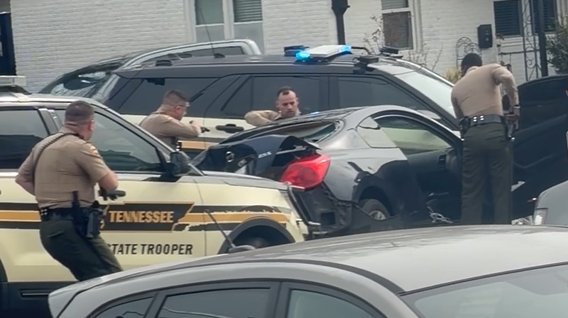
She meant the raids. The arrests. The fear that settled over immigrant neighborhoods this past year.
I understood the question. It is not in the news the way it once was. Like so many things, it has drifted toward the edges of public attention.
Last week, I attended a gathering hosted by the Institute for Public Service Reporting. It was held in an art gallery, all white walls and high ceilings, paintings and sculpture arranged around a hundred folding chairs. At the front of the room, two red sofas held a panel of reporters who had spent months documenting immigration arrests across Memphis and Shelby County.
One by one they described what they had seen.

The numbers kept climbing.
Families separated.
Parents gone.
Children alone.
At one point, reporter Meghnad Bose projected a White House website onto the screen behind him. He was looking for a statistic, something about the number of arrests. I do not remember the number.
What I remember is the website.
Against a field of stars, in the glowing green typeface of an old science-fiction movie, appeared these words:
For 60 years, the U.S. government has kept a closely guarded secret.
Aliens have been walking among us.
The room grew still.
At first it seemed impossible. It looked like satire. Something manufactured for social media. A parody someone had forgotten to label.
But it was real.
A real government website, paid for by the American people.
The aliens, it explained,
They’ve shopped in the same stores, attended the same classes as our children, and lived seemingly normal human existences.

Then came the verdict:
They do not belong here.
But it was not the sentence I kept staring at. It was the word underneath it….
Alien.
History is full of moments when human beings are renamed. The words change from century to century. The purpose rarely does.
The name changes.
The story changes.
Then the people themselves begin to disappear beneath the language.
The website encouraged citizens to report suspicious activity. It kept a running tally of arrests. Its final instruction was blunt.
Deport them all.
The panel moved on.
The reporters kept talking.
But I was still thinking about the word.
Alien.
Days later, Steve and I drove to a small brick house in Berclair with four boxes of food in the back of the truck.
Mauricio Calvo came with us. He runs Latino Memphis. He spoke the language that let a frightened woman’s shoulders relax.
The woman who came to the door was named Keyla.
She is Guatemalan. She is beautiful. Her hair swept up and stacked high on her head, a baby on her hip, two older children gathered close behind her. A teenage daughter with watchful eyes. A son, Matteo, long dark hair, who kept one hand on his mother’s arm the whole time we stood on the porch.
This is the face my government calls an alien. This grace. This woman holding her children together with her own two hands. They do not belong here, the screen said of her, in green letters, while she stood on her own porch more rooted, more present, than I have ever been.
Her husband was taken four months ago.
He had no record. A minor traffic stop took him from them, and then he was gone. He had been the family’s provider.
Since then, she has held the family together on her own. She cleans houses when she can find someone to watch the children, which is not often.
The baby is eight months old. His father has been gone for half of that small life. The child will not remember him.
They have no telephone. When Keyla first heard about our pantry, a friend had to call for her because there was no other way for her to reach us.
Through Mauricio, she told us they were glad we came. That there was no food in the house.
I looked past her into the kitchen and saw that this was true.
Our boxes were an abundance. Staples, fruit, meat, eggs. Diapers. Formula for the baby. We set them down on the porch near a worn bench seat salvaged from a vehicle and pressed into service as porch furniture.
Here is what I keep returning to.
The website does not say Keyla. It does not say, Matteo. It does not name the baby or the daughter. It cannot. Naming them would undo the machine, because the machine depends on erasing names.
Alien. It. They.
First, the name changes. Then the story changes. Then the people disappear beneath the language, and the disappearing becomes easy, because by then no one is being taken from anyone. We are only, in the words of my government, returning it safely to its place of origin.
But I stood on that porch. I know her name.
And here is what I have to admit. Next week, Steve and I are getting in the car and driving to the cool of the California coast to escape the Memphis heat. We can do that. We can leave the heat whenever it presses too hard.
But, there is another heat that bears down on the people who cannot pack a car, who have no telephone to call for help, who answer every knock at the door not knowing whether it will be a neighbor with a bag of oranges or someone else entirely. It does not take a summer vacation. It is bearing down on Keyla tonight, on her porch, with her sleeping children and her husband’s absence.
We can leave. That is the whole truth of it. We can drive west and let the season pass somewhere kinder.
Keyla cannot leave. She is rooted to that porch, to that kitchen, to the eight-month-old who will not remember his father.
I do not know what will become of her. I will not pretend that I do.
I know only that when we come back from the coast, we will load the truck again, and again the week after that, and that it is not nearly enough, and that we will do it anyway, because she belongs here, and so, God help us, do we.